
Direct Answer
Retaining walls on Puget Sound slopes must be engineered for hydrostatic pressure, saturated soils, and freeze-thaw cycles. Nearly 80% of wall failures are caused by poor drainage — not structural weakness.
- Retaining walls prevent slope failure, soil erosion, and hydrostatic pressure damage on Puget Sound hillside properties
- Drainage (French drains, gravel backfill, weep holes) is the #1 design factor — poor drainage causes ~80% of wall failures
- Best materials for the PNW: natural basalt, concrete blocks, reinforced concrete, and Corten steel
- Walls over 4 feet in Seattle require a permit, drainage plan, and often a geotechnical engineer’s stamp
- Permit fees in Seattle range from $180–$720; engineering costs run $500–$3,000+ separately
- Professional retaining wall projects can increase property resale value by 15%–20%
The proper design of a retaining wall on a slope transforms unstable, steep ground into a secure and functional outdoor living space while preventing costly soil erosion. For homeowners in Redmond and the Greater Seattle area, these structures are essential for managing heavy Pacific Northwest rainfall and protecting property value.
By using a comprehensive design-build approach, you can reclaim your yard and create a beautiful, multi-tiered retreat. If you own a hillside property along Lake Washington or in the Eastside highlands, your yard shouldn’t be a source of stress every time the clouds roll in. Many local homeowners struggle with unusable steep ground, drainage issues, and the fear of slope failure.
At Green Spaces Landscaping, we specialize in integrated solutions that combine elite engineering with aesthetic appeal. We don’t just build walls; we create expanded living areas using in-house craftsmen to ensure your investment thrives year-round.
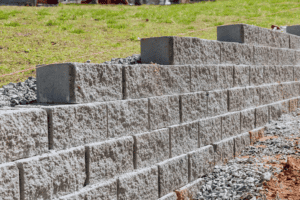
How Do Retaining Walls Stabilize Slopes in the Puget Sound?
The primary function of a retaining wall on a slope is to resist hydrostatic pressure and prevent gravity from pulling soil downhill. By creating level terraces, these walls reduce the speed of water runoff and anchor the hillside. This process protects your home’s foundation and prevents slope failure during the wet winters of the Pacific Northwest.
In the Greater Seattle area, the “angle of repose” for local soil often requires structural intervention to remain stable.
Why This Matters: In Puget Sound’s glacial-deposit soils, saturated ground can become significantly heavier per cubic foot during winter rain events, making engineered drainage not just a best practice, but an engineering necessity.
Effective wall construction uses a combination of gravel backfill and geogrid reinforcement to ensure the earth stays exactly where it belongs. Geogrid reinforcement works by interlocking with surrounding aggregate to prevent soil particle migration and distribute lateral earth pressures, enabling reinforced walls to withstand those pressures up to 40% more effectively than traditional methods.
Preventing Slope Failure
To keep your hillside property safe, your design must account for the specific weight of the saturated soil. We use a strategic approach to ensure your outdoor space remains secure year-round.
- Analyze the site grading and soil type to determine the necessary wall height and depth.
- Install a robust drainage system, including a French drain behind the retaining wall, to redirect heavy winter rainfall.
- Use gravel backfill to prevent water from building up behind the concrete walls or stone structures.
- Incorporate geogrid reinforcement for taller walls to provide extra stability against the hillside.
French Drain: A gravel-filled trench containing a perforated pipe that redirects surface water and groundwater away from the wall’s base — the single most effective method for controlling hydrostatic pressure buildup in Pacific Northwest hillside projects.
What Are the Best Materials for a Retaining Wall in Seattle?
The best materials for a retaining wall in Redmond must withstand constant moisture and freeze-thaw cycles. Concrete retaining walls and natural stone walls are the most durable options for the Pacific Northwest climate. While wood and stone combinations offer a rustic look, materials like basalt or concrete blocks provide the longevity needed for steep ground.
For a contemporary home, many Seattle homeowners now choose Corten steel or recycled concrete for a sleek, industrial aesthetic. These materials don’t just look good, they offer minimal upkeep and resist rot and insects.
Material Comparison for Sloped Yard Projects
| Material Type | Durability | Aesthetic Style | Best Use Case |
| Concrete Blocks | High | Modern / Uniform | Tiered walls and structural support |
| Natural Basalt | Highest | PNW / Organic | Boulder rockery and local stone walls |
| Corten Steel | High | Contemporary | Modern accents and tight spaces |
| Reinforced Concrete | Highest | Industrial | Very steep slopes and high pressure |
How Does Drainage Impact Retaining Wall Design?
A retaining wall drainage system is the most critical component of any hillside project in the Greater Seattle area. Without a way for water to escape, the pressure behind the wall can triple during a heavy rain event, leading to cracks or a total collapse. Integrated drainage solutions, like perforated pipes and weep holes, allow stormwater management to happen naturally.
Proper drainage also prevents the “freeze-thaw” damage that often plagues poorly built walls in Washington State. By using a French drain behind the retaining wall and specific site grading, we ensure that runoff doesn’t pool near your patio or dining area. This keeps your outdoor environment dry and usable even after a heavy winter storm.
Why This Matters: Seattle’s Seismic Design Category D classification and strict local drainage plan requirements mean every retaining wall project with a permit must address hydrostatic pressure by code — not just by preference.
What Are the Permit Rules for Retaining Walls in Seattle and Redmond?
Understanding local permit requirements is essential before any slope project begins. In Seattle, walls 4 feet or under (measured from the bottom of the footing to the top) typically do not require a construction permit, provided the site is not in an Environmentally Critical Area (ECA) and no damage to adjoining properties is expected. Walls above that threshold require a new construction permit from the Seattle Department of Construction & Inspections (SDCI), along with a drainage plan.
In Redmond and unincorporated King County, walls 4 feet or less are generally exempt from permits, though any wall on a steep slope or supporting additional surcharge load (such as a driveway or structure) will require engineered plans and local approval. Permit fees in Seattle typically range from $180–$720 for standard walls, with structural engineering costs ranging from $500–$3,000+ separately. Plan review typically takes approximately 4 weeks.
Important: Always verify requirements with the Seattle SDCI or Redmond Building Department before construction begins, as site-specific conditions — especially ECA designations — can change permit requirements.
Frequently Asked Questions: Retaining Walls on Puget Sound Slopes
Do I need a permit for a retaining wall in Seattle?
In Seattle, retaining walls 4 feet or under (measured from footing bottom to wall top) generally do not require a construction permit, provided the site is not in an Environmentally Critical Area. Walls taller than 4 feet require a permit, a drainage plan, and review by the Seattle SDCI.
What is the most common cause of retaining wall failure on slopes?
As highlighted in our design summary, hydrostatic pressure from trapped water is the primary culprit. When water cannot escape, the weight behind the wall can triple during a heavy rain event, causing structural failure.
What retaining wall materials are best for the Pacific Northwest climate?
Natural basalt and reinforced concrete offer the highest durability for wet, freeze-thaw conditions. Concrete blocks provide a cost-effective modern option, while Corten steel is popular for contemporary hillside designs with minimal maintenance.
How much does a retaining wall cost in Seattle, WA?
Retaining wall costs in Washington average $33–$48 per square foot. Most full hillside projects range from $3,500–$9,645 nationally, with Seattle-area projects typically running higher due to site grading complexity and permit requirements.
How deep does a retaining wall footing need to be on a steep slope?
Footing depth varies by wall height, soil type, and slope angle. For taller walls on steep Puget Sound slopes, a geotechnical engineer must specify depth to ensure the footing sits below the frost line and in stable, non-saturated soil.
Can I build a terraced retaining wall system on a steep hillside?
Yes. Multi-tiered terrace systems are one of the most effective methods for managing steep hillsides in the Eastside and Greater Seattle area. Each wall tier reduces soil pressure, slows runoff, and creates flat, usable outdoor living space. Walls in a tiered system still individually follow the 4-foot permit threshold rule.
What is geogrid reinforcement and when is it required?
Geogrid is a polymer mesh installed in layers between soil and backfill to add tensile strength and prevent lateral soil movement. It is typically required for walls over 4 feet on steep slopes and can increase slope stability by up to 70% compared to unreinforced methods.
How long does it take to get a retaining wall permit in Seattle?
Standard permit plan review in Seattle typically takes approximately 4 weeks. Complex projects requiring structural review, geotechnical reports, or ECA variance may take longer.
Transform Your Sloped Property Today
If you’re a homeowner in Redmond or along the shores of Lake Washington, you know that a sloped yard can feel like a wasted opportunity or, worse, a looming liability. Our comprehensive design-build approach is specifically engineered to turn your “difficult” hillside into a stunning, multi-tiered outdoor retreat that stands up to the unique challenges of the Pacific Northwest.
Industry data shows that professional landscape design can increase your property’s resale value by up to 20%, making a structural retaining wall a smart, long-term investment in your home’s equity. Rather than dealing with multiple subcontractors, you’ll work directly with our skilled, in-house craftsmen who manage everything from the first design to the final stone placement.
Your yard shouldn’t be a liability. Let’s build a space where you can finally entertain, relax, and enjoy the views.
Schedule a site visit: (425) 861-3535